
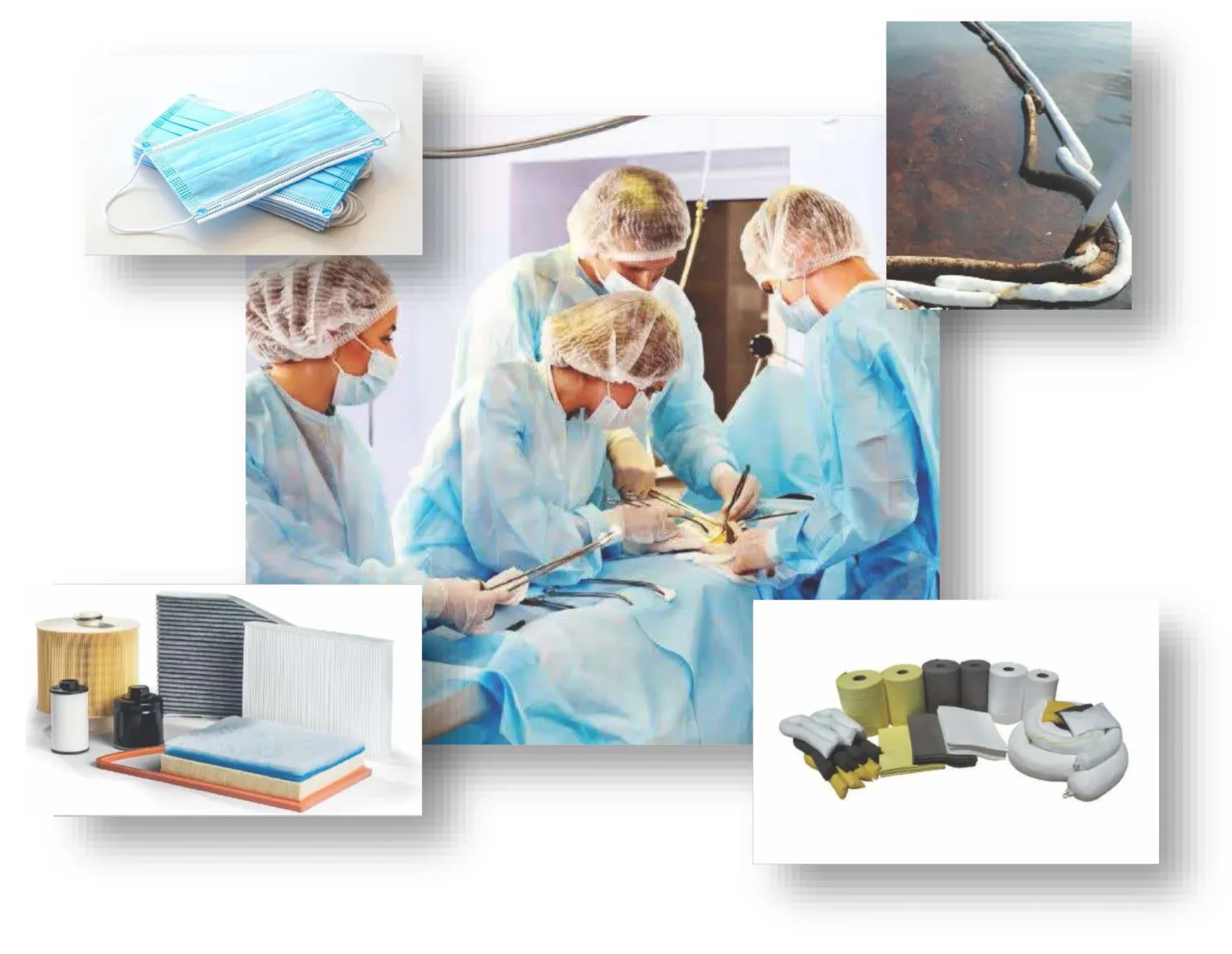
Our Meltblown fabrics, which we produce by laying fine and continuous filaments in an isotropic manner with high-speed airflow in a 100% PP structure, offer solutions for the most critical applications in the sector with their high filtration and absorption capacity. We serve with an annual production capacity of 720 tons.
On our Meltblown line, where we produce in 160 cm width and 15–350 gsm weight range, we produce fabrics with a filtration capability of over 99% BFE and PFE rates using Corona treatment. These fabrics are solution partners in high-quality mask and filtration applications. In addition, by combining them with Spunbond layers, multi-layered, high-strength, and high-absorption products are obtained in composite structures such as SMS and SMMS.
While Meltblown alone offers superior filtration, when combined with Spunbond, it also gains mechanical strength.
Meltblown technology is an indispensable production method in applications where filtration and absorption performance is the most critical in the nonwoven industry. The 6-8 micron thin fibers effectively capture small particles in air and liquids by creating a large surface area. Corona treatment application increases the fiber surface energy and further increases the filtration efficiency.
In composite structures, the Meltblown layer forms the main filtration or absorption barrier, while the Spunbond layers provide mechanical strength and surface smoothness. The SM (Spunbond-Meltblown) structure offers sufficient performance for simple filtration and absorption applications, while the SMS structure provides a combination of fluid barrier and strength in medical applications such as surgical gowns and masks. The SMMS configuration is preferred for critical applications requiring the highest barrier performance.
UV, antistatic, FR, hydrophilic applications and different color options can be applied to our fabrics.
Application Areas
Medical and FFP2 type mask, dust bag, air filter, cooler filter, industrial wet wipes, automotive filtration, insulation and sound insulation, medical applications (surgical gown, drape), lining layer for composite structures, sorbent products.
Technical Specifications
Width: 160 cm | Weight: 15–350 gsm | Fiber fineness: 6–8 microns | Max roll diameter: 105 cm | Core diameter: 76–152 mm | Filtration: BFE/PFE >99% (with Corona treatment) | Composite structures: SM, SMS, SMMS | Applications: Corona, UV, FR, hydrophilic, antistatic, antibacterial | Production capacity: 720 tons/year
Spunbond fabrics consist of 15-30 micron thick filaments and provide high mechanical strength. Meltblown fabrics, on the other hand, are produced from 6-8 micron thin fibers and offer superior filtration and absorption capacity thanks to their much larger surface area. However, Meltblown is mechanically weak on its own; therefore, it is combined with Spunbond and used in composite structures.
Corona treatment is the process of increasing fiber surface energy by applying high-voltage electrical discharge to the fabric surface. As a result of this process, the Meltblown fabric gains an electrostatic charge and its capacity to attract particles in the air increases. BFE (Bacterial Filtration Efficiency) and PFE (Particle Filtration Efficiency) rates exceed 99%; this is a critical requirement for medical masks and high-performance air filters.
SM structure: Basic filtration applications, dust bags and industrial cleaning cloths. SMS construction: Surgical gown, medical mask, hygiene product components - providing a balance of fluid barrier and durability. SMMS construction: Critical medical applications, high barrier protective clothing - offering the ultimate in fluid and particle protection performance.
